Journey overview
Roughly 1.5 million wildebeest and 250,000 zebra move in a continuous loop through the Serengeti-Mara ecosystem, chasing rainfall rather than a calendar. This guide breaks the Great Migration down month by month, so you know exactly where the herds will be, what's worth seeing, and which Hill Trust migration safari package matches your travel dates.
Whether you're chasing the Ndutu calving season, the Grumeti River crossings, or the dramatic Mara River crossings further north, our guides time every departure to the current ranger reports from the ground, not a fixed brochure date.
01 How the Migration Actually Works
The Great Migration is a continuous loop, not a single event: roughly 1.5 million wildebeest, 250,000 zebra, and tens of thousands of gazelle chase rainfall and fresh grass around the Serengeti, the Ndutu plains, and Kenya's Maasai Mara. The herds don't follow a fixed schedule, so a late rainy season can shift crossing dates by two to three weeks. What stays consistent is the shape of the loop: calving in the south, a push north and west as the plains dry out, two river crossings to reach the greener north, and the short rains pulling everything south again.
02 Calving Season: Why February Matters
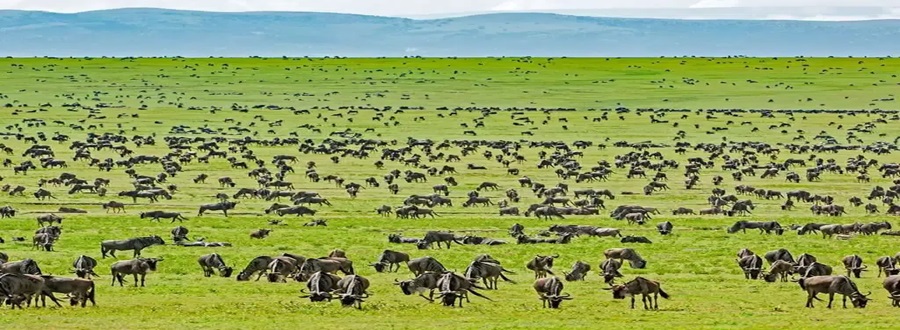
Between late January and early March, around 500,000 wildebeest calves are born on the short-grass plains around Ndutu, most within a two-to-three-week window in February. This synchronized birthing overwhelms predators with sheer volume, lowering the percentage any single predator can take.
Ndutu's volcanic-ash soils, drifted from Ngorongoro and Olduvai, are unusually rich in calcium and phosphorus, minerals lactating cows need in quantity. The herds time their arrival to the short rains that green this specific belt of grassland, then move on once it's grazed down.
For visitors, this is also peak predator season: cheetah, lion, and hyena concentrate here because newborn calves, which stand within minutes but aren't yet fast, are the easiest prey of the year.
03 River Crossings: Grumeti and Mara
As the southern plains dry out from April, herds push north through the Western Corridor toward the Grumeti River, typically active May through June. Grumeti crossings are smaller than the Mara's but the river holds some of East Africa's largest Nile crocodiles.
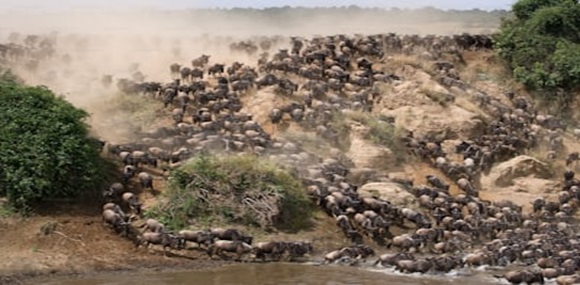
The marquee event is the Mara River, crossed repeatedly from July through October as herds move between the Lamai Wedge and the Kenyan Mara, often re-crossing the same stretch several times in one season as grazing dictates.
Grumeti River
Active May-June. Smaller herds, large crocodiles, fewer vehicles than the Mara.
Mara River - Lamai Wedge
Active July-October. The most photographed crossings of the migration.
Mara River - Kogatende
Active August-September. Herds cross back and forth as banks are grazed out.
04 So, When Should You Go?
January-March: calving and predators
Choose this window for newborn calves and high predator-prey drama on open plains, and to pair easily with a Ngorongoro Crater extension.
June-October: river crossings
Choose this window if a Mara River crossing is the image you came for. August and September are busiest, so book camps near the Lamai Wedge or Kogatende six to twelve months ahead.
April-May or November: fewer crowds
The rains thin visitor numbers substantially while wildlife viewing stays strong in the Western Corridor and central Serengeti, with lower camp rates.
05 Migration Safari Packages
Every package below is timed to a specific migration phase, and adjusted by a few days based on the latest ranger reports closer to your departure.
| Package | Best timed for | Duration | From |
|---|---|---|---|
| Ndutu Calving Safari | Calving season, Jan-Mar | 5 days | $1,150 |
| Western Corridor Migration Safari | Grumeti crossings, May-Jun | 6 days | $1,700 |
| Northern Serengeti Crossing Safari | Mara River crossings, Jul-Oct | 7 days | $2,450 |
| Full Migration Loop Safari | Any season, multi-region | 9 days | $3,200 |
06 Frequently Asked Questions
There is no single best month, only a best month for what you want to see. Calving is February, Grumeti crossings run May to June, and Mara River crossings peak July to September.
No. The herds follow rainfall, not a calendar, so the ranges here are multi-year averages. We adjust itineraries close to departure based on current ranger reports.
The south, around Ndutu, is stronger November to March for calving and predator action. The north, around the Mara River, is stronger July to October for river crossings.
For July to September departures, book six to twelve months ahead, since camps near the Lamai Wedge and Kogatende sell out first.
On this page
Plan your migration safari
Tell us your travel window and we'll match it to the right migration phase.